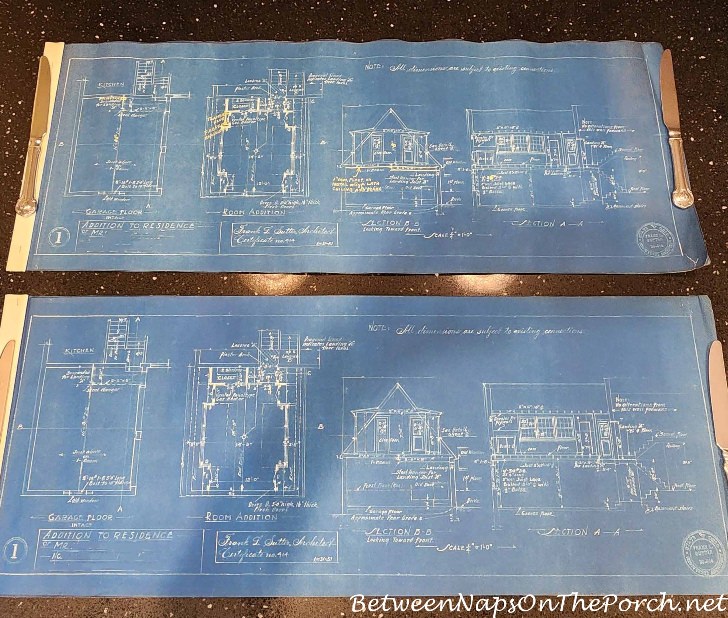
A few months after I purchased the Dollhouse, one of the previous owners texted to say he would be “dropping something by the house.” I was surprised and delighted when the shopping bag he left on the front porch contained two rolled-up blueprints depicting the exterior of the home. I was so excited to have these, and my immediate thought was to have them professionally framed so I could display them somewhere inside the house.
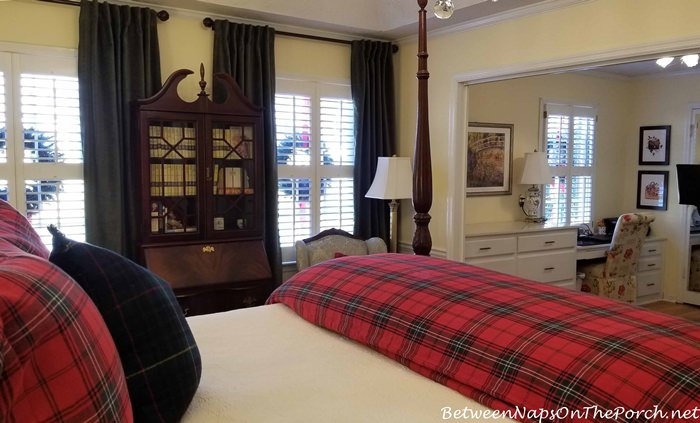
Many years ago, I wanted to have a Hermes silk scarf framed for my dressing room, visible through the opening off the master bedroom in this photo below.
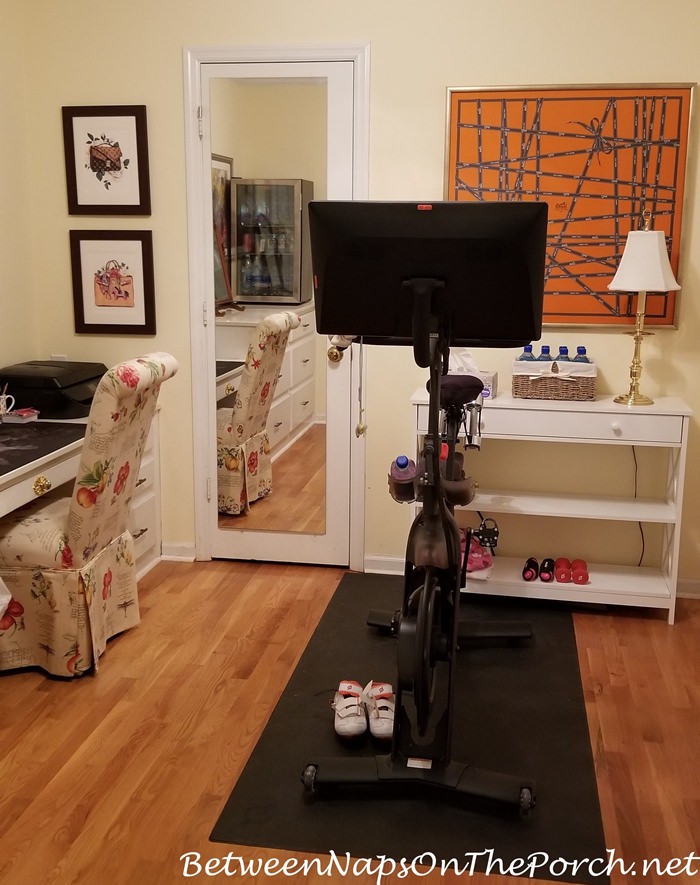
I took the scarf to a framery that I have used in the past, and that’s where I first learned about Tru Vue museum glass, a special glass that offers 99% UV Protection and is anti-reflective. Once I saw a sample of Museum Glass, I knew that was the method I wanted the shop to use when framing the scarf. The difference between regular framing glass and Museum Glass was astounding. With Museum Glass, it looks as if there’s nothing there—like one could reach right through and touch the item behind the glass. I was amazed! The only downside is that Museum Glass is much more expensive than regular framing glass.
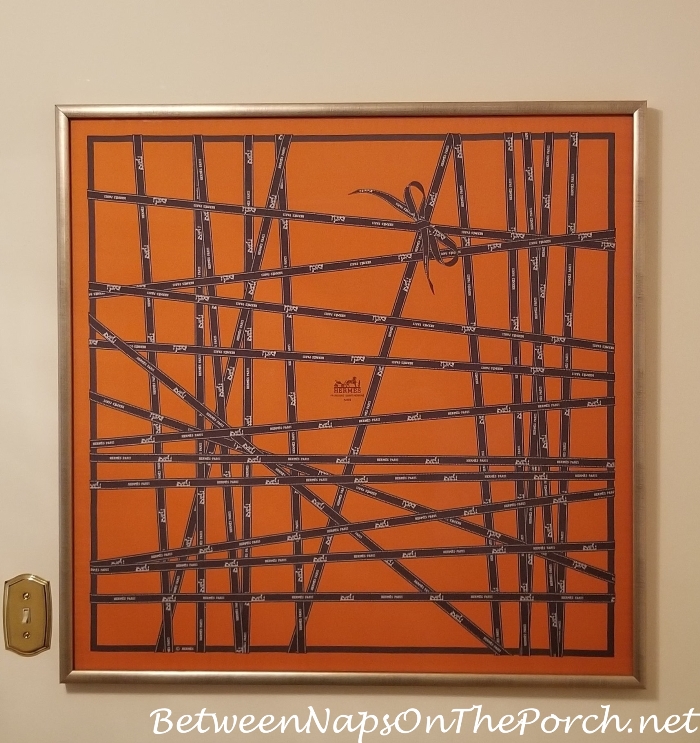
I decided to go for it since the room where this scarf was to be displayed was quite sunny. The result was beautiful and definitely worth the expense! It’s not just the protection that makes Museum glass worth the expense; it’s the invisibility of it! It looks as if nothing is covering the scarf at all—like invisible protection!
So when the wonderful blueprints of the Dollhouse landed in my possession, the first thing I thought about was having them framed in Museum Glass. I took them to the same framery I had used for the scarf. I was surprised and disappointed when they recommended against framing them with Museum Glass, or really any type of glass. They weren’t sure that Museum Glass would offer the full protection blueprints require. Drat! That was really disappointing news. These blueprints were too good to just keep rolled up inside a protective tube, which is where I had placed them after they were dropped off. Update: Forgot to mention, the frame shop suggested having a photographer that they know take color photos of the blueprints and framed those instead of the actual blueprints. So that’s an option as well, although it will definitely add to the cost.
Disappointed and not fully wanting to believe that the blueprints could not be framed with Museum Glass, I decided to email the company that makes the glass to ask if what the frame shoppe had said was true, and that not even Museum Glass would be enough protection for the blueprints. Here’s the reply that I received:
Hi Susan,
I am an account manager from Tru-Vue. Your comment about your framers’ recommendation may be true. Depending on how much light there is in the room can still affect the fading. Fluorescent lighting alone generates 8% UV. A lot of museums and art galleries do you use Optium Museum Acrylic. Some feel it preserves better than Museum Glass. Blueprints will fade quicker than most prints and is likely to fade no matter what. However, there is no other glazing better than Museum Glass or Optium Museum Acrylic when it comes to preservation.
I hope this helps.
Thanks,
Julian
I had not heard about Optium Museum Acrylic, but I discovered it’s also a Tru Vue product. A few months later, I was looking through old photos of the Dollhouse when it was listed for sale 5 years ago by the family who lived here for over 20 years—not the family who had just moved out. Look what caught my eye! Are those blueprints I see hanging on the wall‽ I texted Katie, whom I’ve come to know quite well, and asked if those might be blueprints for the house. She said, Yes, and that she had been meaning to drop those by to me. A few weeks later, true to her word, she dropped by six beautifully framed blueprints.

I am super thankful to have been gifted these 1936 detailed blueprints! They are a treasure! One of the first things I noticed when looking at them was a lot of white, splotchy areas. Was that sun damage? Not sure.
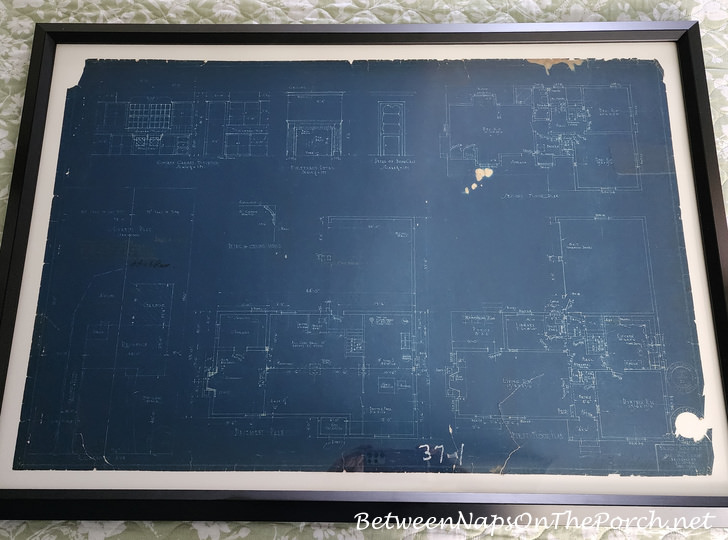
They appear to have been framed with normal framing glass, and many of them once hung in the hallway leading to what is now my office and to the second floor. The window that’s very high up in that staircase does not have anything covering it at all. Since it’s so high up, no one can see in, so I don’t think it’s ever had a window covering of any type. I wondered if this is what can happen to blueprints when they are exposed to sunlight.
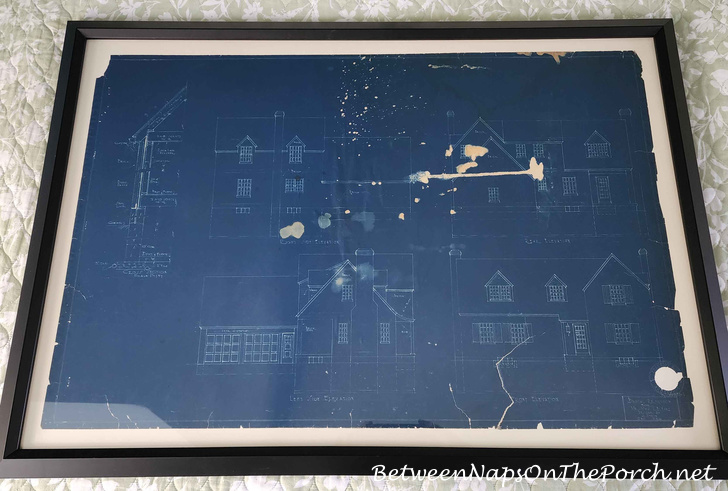
I am considering using the Optium Museum Acrylic for the two blueprints that I have that have never been framed. What do you think? Would you use Optium Museum Acrylic since it is “trusted by the world’s most renowned museums,” as stated on the Tru Vue website?
Here’s some information about Optium Museum Acrylic from the Tru Vue website here: Optium Museum Acrylic. Read about all the products they carry here: Tru Vue.
Optium Museum Acrylic® is a virtually invisible acrylic that performs like glass and is trusted by the world’s most renowned museums to deliver a stunning, crystal-clear, high-definition viewing experience. Designed to meet the most uncompromising aesthetic and preservation standards, this museum acrylic offers state-of-the-art peace of mind, making it ideal for high-value artwork, photography, and sensitive materials.
Optium Museum Acrylic sheets, Optium Museum Acrylic Cases, and Seamed Optium Museum Acrylic deliver:
-
99% UV blocking to help protect against damage and fading caused by UV rays
-
Anti-reflective coating for optimal light transmission and nearly invisible viewing
-
Anti-static protection for use with static-sensitive materials. Reduces cleaning and fabrication time
-
Abrasion resistant acrylic for long-lasting durability, sustainability, and performance
-
Shatter resistance for enhanced safety against injury and damage to artwork
I’m very tempted to give the Optium Museum Acrylic a try. What do you think? If it’s good enough for museums and if I displayed the prints where they are not in a really sunny room, maybe they would be fine. Let me know what you think and if you’ve had any experience with Museum Glass or Optium Museum Acrylic by Tru Vue.


I would strongly suggest saving the blueprints in a file, but having black on white or dark blue on white copies made to frame…much easier to see and the originals will be safe.
I forgot to mention that in the post. The frame shop suggested having a photographer that they know take color photos to frame. That would probably be the more prudent way to go. Thanks for reminding me of that, Gina; I totally forgot to mention that in the post. I should go back and add it.
I wonder if you could have them scanned and reprinted on non-blueprint paper…thus saving the originals, but enjoying the history and esthetic of the prints by framing copies…?
Hi Susan,
I have not had any experience with either of those types of glass, but the Optium that Julian recommends sounds good to me. Those prints really are special, and the blue prints that you are wanting to frame look to be in great shape. I can see no fading or discoloration, so ideally you can keep them looking that good for a long time.
I love that you have all these blue prints! Even the damaged ones. What a lovely thing to display in your home and to someday leave for future owners. You didn’t mention how much more the special glass costs, but unless it’s truly prohibitive, I would go with that, myself. Good luck deciding. I hope you’re happy with the outcome.
Yes, I think photographs would preserve the color better. I used to work with large blueprints in the engineering department of a company I worked for. They do indeed fade over time.
We consulted with an architect when we discovered a tube of original blueprints in our home. He told us he never frames originals, but color copies, made by a high quality printing company. They use a special photographic process, as well as specialized high quality papers. Neither my husband or I remember the specific types of paper, but I’m sure a reputable printing company would give you the available options.
this is my vote too
Susan, Thank you for this post. I have the original blueprints for an historic
home I owned and have been stymied. Admittedly mine are even older and the prints are quite friable. Thus, I keep them filed & I shy from the temptation to handle them. It is fascinating to learn the difference in paper composition. I don’t think I dare handle them in an attempt to frame but you have caused a genuine “aha” moment introducing photography. I wish you great success in
your personal endeavor.
How wonderful that you have blueprints of the Dollhouse, Susan! I have a ninety one year old house that I inherited when my father passed away, and I’m fortunate to have blueprints of the house. It sounds like framing a quality copy of the blueprints would be the wisest way to go. You could talk to a museum about the best way to store the originals to keep them well preserved.
I LOVE your framed Hermes scarf!
I would say go with museum framing. But, why spend a lot of money on this when you are selling house? Blueprint shows nothing you have done to house. Some people don’t care about blueprints unfortunately.
I, too, would consider having them photographed for framing because there will be no way to protect the originals completely. In addition, once photographed, some of the damage can be “photoshopped” out before having them printed for your frames. Generally, you should at least request 300 DPI for clarity but you may want to request a higher DPI. Just let the photographer know your ultimate plans for the largest print you will want to frame. I’d make sure I was given the rights to the photographs and a copy of the image files should you choose to go with this option because photographs are considered the property of the photographer. Then, you might be able to just use a less expensive glass knowing that you will always have the right to reprint and/or use the prints in any way you might wish in the future.
Blueprints are destined to fade because of the way they are made: utilizing light-sensitive chemicals to create distinct white lines on a rich blue background. Architects used to store them in drawers that were light tight. I’d recommend photographing them and printing them on a paper similar to what they are on. The originals are a treasure and should be preserved.
Skip the museum glass and have the original blueprints scanned by a specialty art printing business in your town. In our area, we use a company that does high resolution art scanning, precise color matching and archival giclee printing. Artists use companies like this to print high quality images of their digital artwork suitable for framing.
I would want to have copies made, frame the copies and store the original in an archival file box ( I use Gaylord for archival material purchases).
As most people have advised, take a photograph to have framed. That is what genealogists do for family photos and documents they want to display.